


As you read this, you are probably sitting or standing still. You might be walking or riding in a car, but most likely, you are in a stationary position.
However, while you are sitting still, the world beneath you is moving. Fast. You can (indirectly) perceive some of this motion as you watch the sun rise and set, the seasons change, or – as happened recently – the moon eclipse the sun. But in large part, this motion is imperceptible.
What is this motion I’m referring to?
At this very moment, the Earth is spinning at about 1,000 miles per hour – faster than the speed of sound.
What’s more, while the Earth spins around at breakneck speed, it is also rocketing through space at 67,000 miles per hour as it makes its annual orbit around the sun.
As if that’s not enough speed, our entire solar system is simultaneously traveling around the center of the Milky Way Galaxy at roughly 450,000 miles per hour.
While all this interstellar spinning takes place, the Milky Way Galaxy itself is sprinting through space at 1.3 million (!) miles per hour.
As someone with a sensitive inner ear, I’m grateful not to be able to perceive the movement of this cosmic spinning teacup/high-speed train we’re riding. I appreciate feeling as if I’m sitting still in an office chair, inside an immobile office, inside a stationary office building, instead of feeling nauseous.
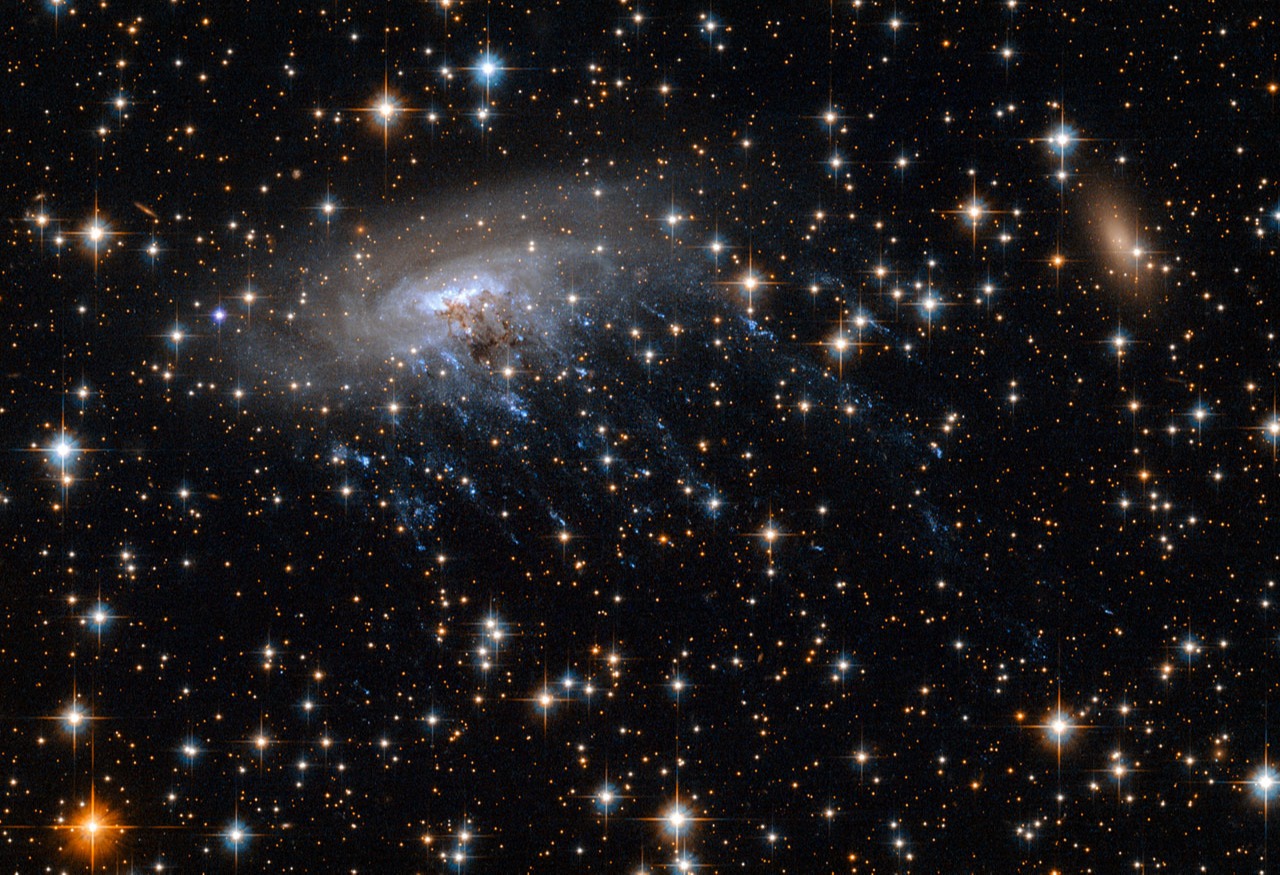
Source: NASA, ESA; Acknowledgements: Ming Sun (UAH), and Serge Meunier
A similar phenomenon takes place whenever you look at your stock portfolio online or in a statement. What you see is a simple list of the stocks and/or funds in which you’re invested, alongside an indication of their price movement.
However, what your money is actually invested in are companies, which in turn are comprised of thousands, or tens of thousands, or hundreds of thousands of people. Every person employed by these companies is in perpetual motion, performing a specific role or function within the company. Research is conducted. Products are developed and tested. Sales initiatives are undertaken. Hiring decisions are made. Health and safety issues are dealt with. Supply chains are managed. Billions of pieces of communication are transmitted across the world. The list of activities is endless. The collective efforts of these people, culminating in the goods and services put forth by the company, are in turn received or rejected by other people (consumers, community stakeholders, investors, etc.). Thus, every company is in a constant state of swift, complicated, multilayered motion.
For investors who hold diversified stock portfolios comprised of tens, or hundreds, or even thousands of underlying companies, the subliminal motion taking place inside and around these companies would be completely overwhelming if it could be perceived. Our brains could not handle the sheer rate of change taking place on a minute-by-minute basis. On the one hand, it is marvelous to consider the scope and speed of activity taking place at any given moment within the companies we’re invested in. On the other hand, it is a mercy that we do not have to try to swim through the deluge of data that we would be faced with if we could perceive this movement and complexity. It is far less dizzying to see a list of positions on a statement, with a price change reflecting (albeit imperfectly) the overall direction in which the companies are headed.
Thankfully, the Earth spins predictably on its axis, giving us day and night. It rotates predictably around the sun, giving us seasons. Though we do not perceive these motions, we do perceive – and benefit from – the results.
Likewise, the galaxy of companies that we call the market moves predictably upward over time, providing gains and financial independence to the patient investor. Though the constant movement of internal and external forces impacting the underlying companies tends to escape our notice, we perceive – and benefit from – the results of this collective enterprise.
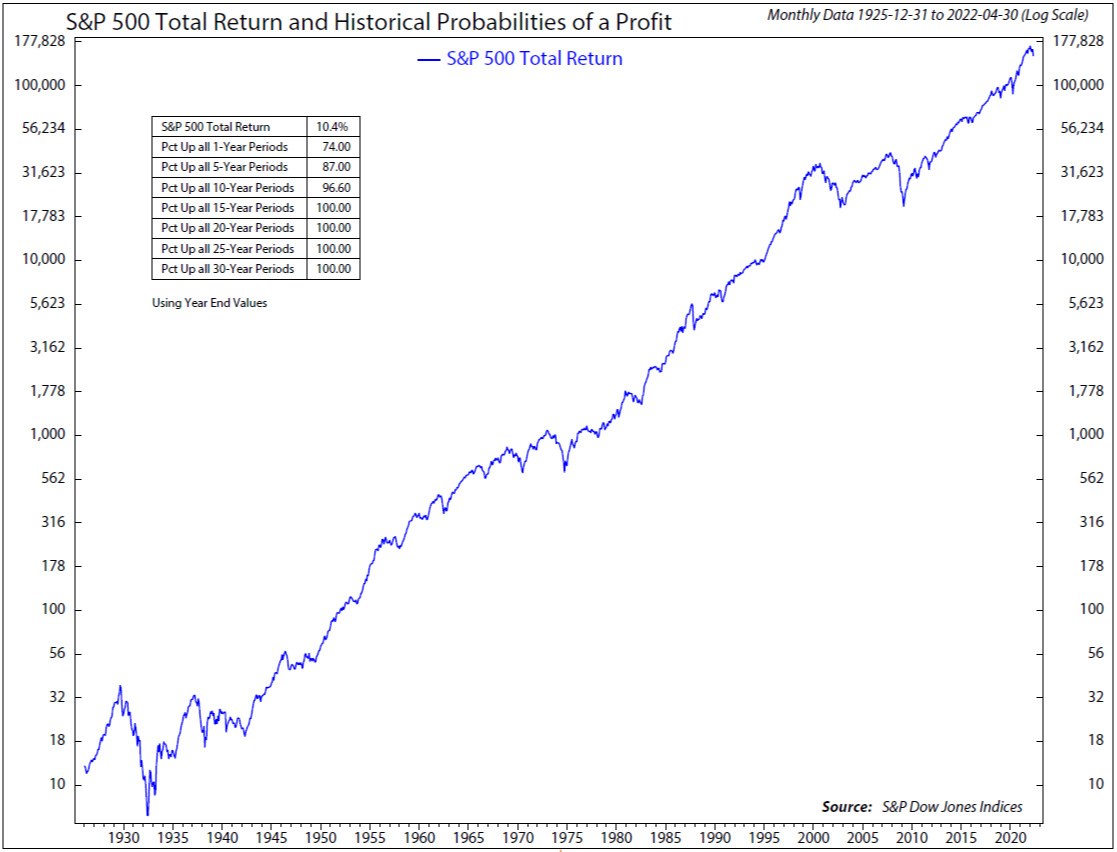
Source: Ned Davis Research
We cannot control the motion of the universe, nor can we control the universe of motion hidden within our portfolios. All we can control are the steps that we take as investors, which ought to be informed by observable patterns in the market’s movement. As the chart above illustrates, the most obvious pattern is the increased likelihood of success across longer timeframes. Thus, in a frenetic world that never stops moving, it pays to take a more cosmic perspective, remaining still, patient, and resolute.
And Now For Something Completely Different...