
In the Markets Now: Elections and Investing
The fastest growing sport in the world is Formula 1 racing, and the drivers are among the highest paid and most famous athletes on earth. They naturally receive much of the credit when they cross the finish line in first, but many in the industry have long argued that the car matters far more. Former champion Nico Rosberg once put the ratio at roughly 80% car and 20% driver, while other analysis estimates that the car explains nearly 90% of variance in recent races. Perhaps that's a useful framework for investors during election season. Politicians, like drivers, are highly visible and can influence performance, but don’t operate independently of the highly complex machinery beneath them. For markets, that machine is the capitalist system of businesses, workers, consumers, capital, and innovation that keeps the economy growing over time.
Perhaps that's why the U.S. stock market has produced positive average returns across every combination of political control in modern history. Republicans and Democrats have each presided over their share of booms and busts, and each party’s policies can accelerate or constrain parts of the economy. But no combination of party control has fundamentally altered the engine underneath it: the American brand of capitalism that rewards the innovation, investment, and growth behind the world’s best-performing stock market since 1900.

But recognizing that reality and voting with one’s dollars are different beasts. In recent decades, the increasing negativity of the newscycle and the polarization of the populace have both made sticking to an investment plan through election noise all that much harder. A recent study from the University of Arizona found that political polarization significantly shapes investors’ stock market expectations – and even their trading decisions. Based on a sample of more than 12,000 Americans taken from 2015 to 2025, both Republicans and Democrats became markedly more bullish when their own party held the White House…and more bearish when it didn’t. As the great financial journalist Jason Zweig concluded in his summary of the study: “Your vote belongs in the ballot box, not in your portfolio.”
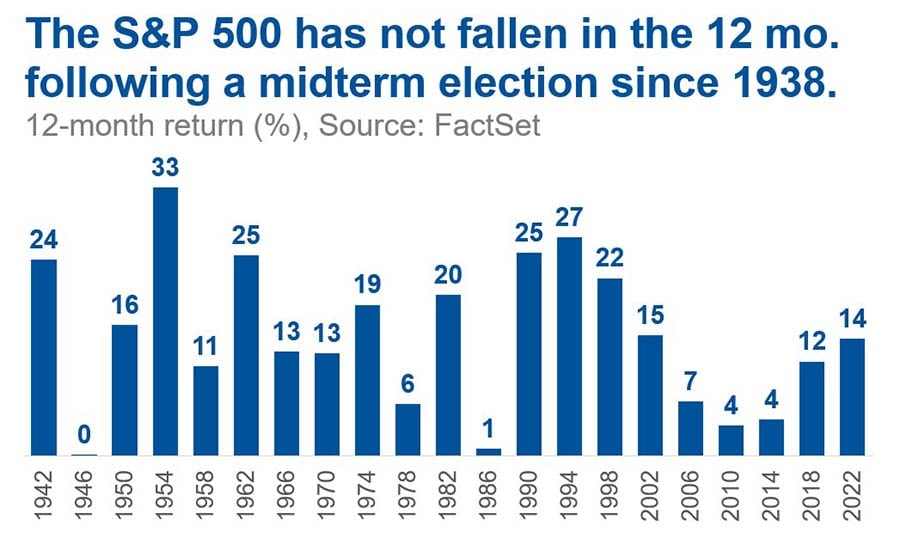
But again, more easily said than done. As famed investor Ben Graham said, “in the short run the market is a voting machine, but in the long run it is a weighing machine.” While the tailwinds of innovation and profitability reign supreme over the longer-term, short-term trading action can be greatly impacted by sentiment. Over the 40 elections since WWII, the S&P 500 has actually been negative, on average, on the day following the election. But across the ensuing year, the average return rises to over 11% as economic fundamentals reassert themselves. Recent history offers two striking examples: shortly after the 2020 election came news of an effective Covid-19 vaccine; weeks after the 2022 midterms came the launch of ChatGPT. The election mattered, but markets quickly had much bigger things to weigh.
Without a doubt, elections do matter – for public policy, national security, and even to a degree, for economic growth and capital markets. But a sound financial plan shouldn’t hinge on who wins an election. And if you, reader, will permit me to abuse the F1 metaphor one last time: politicians of varying parties and ideologies may take turns behind the wheel, but over time, it is the economic engine of capitalism, innovation, and corporate profitability that will carry investors to the finish line.
Disclosures
This is not a complete analysis of every material fact regarding any company, industry or security. The opinions expressed here reflect our judgment at this date and are subject to change. The information has been obtained from sources we consider to be reliable, but we cannot guarantee the accuracy. Market and economic statistics, unless otherwise cited, are from data provider FactSet.
This report does not provide recipients with information or advice that is sufficient on which to base an investment decision. This report does not take into account the specific investment objectives, financial situation, or need of any particular client and may not be suitable for all types of investors. Recipients should not consider the contents of this report as a single factor in making an investment decision. Additional fundamental and other analyses would be required to make an investment decision about any individual security identified in this report.
For investment advice specific to your situation, or for additional information, please contact your Baird Financial Advisor and/or your tax or legal advisor.
Past performance is not indicative of future results and diversification does not ensure a profit or protect against loss. All investments carry some level of risk, including loss of principal. An investment cannot be made directly in an index.
Copyright 2026 Robert W. Baird & Co. Incorporated.
Other Disclosures
UK disclosure requirements for the purpose of distributing this research into the UK and other countries for which Robert W. Baird Limited holds an ISD passport.
This report is for distribution into the United Kingdom only to persons who fall within Article 19 or Article 49(2) of the Financial Services and Markets Act 2000 (financial promotion) order 2001 being persons who are investment professionals and may not be distributed to private clients. Issued in the United Kingdom by Robert W. Baird Limited, which has an office at Finsbury Circus House, 15 Finsbury Circus, London EC2M 7EB, and is a company authorized and regulated by the Financial Conduct Authority. For the purposes of the Financial Conduct Authority requirements, this investment research report is classified as objective.
Robert W. Baird Limited ("RWBL") is exempt from the requirement to hold an Australian financial services license. RWBL is regulated by the Financial Conduct Authority ("FCA") under UK laws and those laws may differ from Australian laws. This document has been prepared in accordance with FCA requirements and not Australian laws.


